
V MANMOHAN
AI Audit Lab — Demonstrating AI-Assisted Purchase Vouching
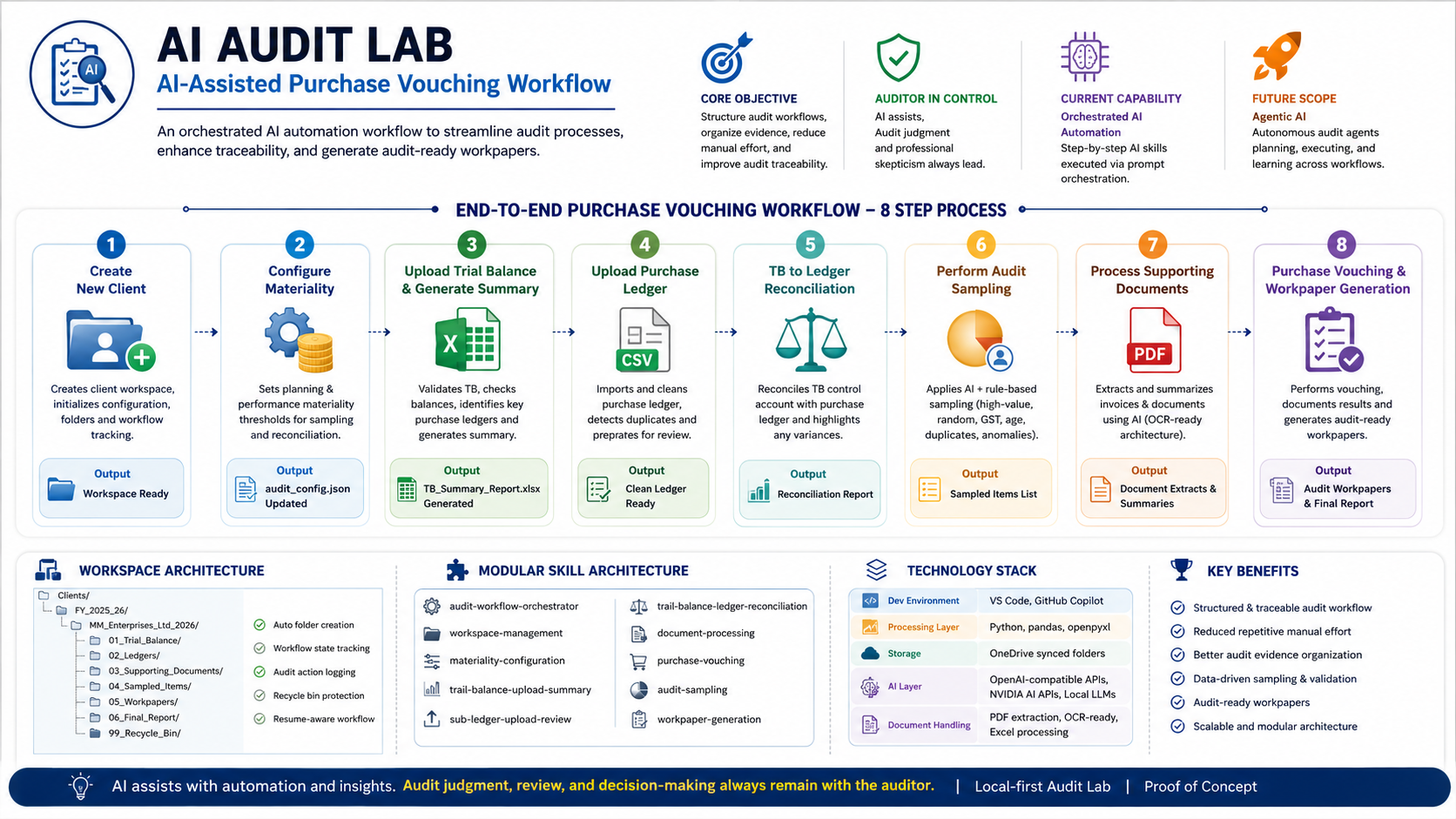
An experimental workspace demonstrating how orchestrated AI automation supports audit workflows, audit evidence management, and purchase vouching in a structured, traceable, and resume-aware manner.
The SKILL.md Framework: To elevate the AI Audit Lab from basic prompt-chaining into a fully autonomous system, the project adopts the SKILL.md open standard to govern its agentic workflows. Acting as a strict standard operating procedure (SOP) for the AI, this structured framework provides three critical architectural upgrades: it preserves precious LLM context windows by dynamically loading heavy audit instructions only when a specific task is triggered; it enforces rigid deterministic boundaries by routing document extraction (OCR) to the LLM while restricting zero-margin-of-error financial recalculations entirely to Python; and it enables stateful, resumable audits by instructing the agent to independently track its progress through local JSON configurations.
Workflow Video Demonstration
Watch the end-to-end vouching sequence operating inside a local-first workspace.
Core Objectives
Bridging audit logic with LLM capability, ensuring professional skepticism remains strictly in control of the human auditor.
Structuring Audit Workflows
Formally defining sequential audit skills so that operations follow a rigorous audit protocol.
Organizing Evidence
Systematically storing client files, vouchers, and generated ledgers in isolated, auditable workspaces.
Reducing Repetitive Effort
Automating mechanical matching, mathematical verification, and OCR field extractions.
Improving Audit Traceability
Maintaining tamper-evident logs and direct audit trails from ledgers back to raw source files.
Supporting Vouching Procedures
Cross-matching Ledger vs. Invoices vs. Purchase Orders vs. Goods Receipt Notes (GRNs).
Generating Audit Workpapers
Compiling verified outcomes, discrepancies, and audit exceptions into formatted, review-ready Excel workpapers.
Workspace Directory Architecture
Each audit client is structured automatically into an isolated folder ecosystem, matching professional engagement management standards.
- Strict Separation: Isolates client evidence, ledgers, and sampling models to prevent cross-contamination.
- Resume-Aware Tracking: Holds execution markers in
workflow_state.jsonto enable stop-and-resume workflows. - Safety First: Features a recycle-bin configuration (
99_Recycle_Bin) preventing permanent loss of audit evidence.
Clients/
└── FY_2025_26/
    └── MM_Enterprises_Ltd_2026/
        ├── 01_Trial_Balance/           # Raw Trial Balance uploads
        ├── 02_Ledgers/                 # Standardized sub-ledgers
        ├── 03_Supporting_Documents/    # Invoices, POs, GRNs, E-Way bills
        ├── 04_Sampled_Items/           # Generated statistical samples
        ├── 05_Workpapers/              # Completed vouching spreadsheets
        ├── 06_Final_Report/            # Drafted audit summaries
        ├── 99_Recycle_Bin/             # Safe delete preservation layer
        ├── workflow_state.json         # State preservation for execution
        ├── audit_config.json           # Materiality limits & parameters
        └── audit_log.json              # Activity audit trail
Technology Stack
Modular Skill-Based Architecture
Under the hood, the lab runs on modular audit skills defined inside .github/skills/. Each skill manages a distinct stage of the auditing process:
8-Prompt Demonstration Flow
The purchase vouching demonstration runs systematically through eight prompt gates, each invoking a dedicated audit skill.
Demonstration video: Executing the 8-prompt workflow.
Step 1: Create New Client
Active Gate- Creates the audit workspace for the client
- Initializes audit_config.json
- Generates the structured folder structure
- Initializes workflow tracking through workflow_state.json
Vouching Verification Matrix
Assertions verified during the automatic vouching sequence (Prompt 8) against Ledger data.
| Audit Check | Verification Description | Assertion Verified |
|---|---|---|
| Invoice Match | Cross-references sub-ledger parameters (date, amount, vendor name) against values extracted via OCR from the physical Purchase Invoice. | Occurrence & Accuracy |
| PO Match | Cross-checks invoice details against the approved Purchase Order (PO) to confirm authorized transaction quantities and rates. | Measurement & Authorization |
| GRN Match | Matches invoice line items with the Goods Receipt Note (GRN) to ensure items were physically received before paying. | Occurrence & Existence |
| GST Validation | Re-calculates Tax values (CGST, SGST, IGST) against the taxable base to ensure ledger accuracy matches statutory rules. | Accuracy & Valuation |
| Vendor Validation | Matches vendor names, GSTINs, and bank accounts between the master vendor list and physical invoices to prevent ghost vendor payouts. | Completeness & Existence |
Design Philosophy & Hybrid Architecture
Combining deterministic calculations with LLM intelligence to build an audit-traceable solution.
Deterministic Processing (Python)
Core math, financial aggregations, and exact dataset reconciliation are handled directly by Python (pandas, openpyxl). Because financial statements tolerate zero margin of error, the system relies on exact calculations rather than LLM inference.
- Trial Balance math validations (Dr = Cr)
- Threshold filter applications for materiality
- Calculations of statutory GST tax tolerances
AI-Assisted Processing (LLMs)
Unstructured language parsing, document classification, OCR verification, anomaly interpretation, and workpaper narrative generation are delegated to LLMs.
- OCR document classification (Invoice vs. GRN vs. PO)
- Interpretation of audit exceptions & writing remarks
- Generating human-readable executive summaries
The Path to True Agentic AI
Transitioning from structured prompt orchestrations to autonomous AI agents that act with safety boundaries.
1Self-Planning & Executing
Autonomously mapping client data, establishing material scope, and identifying relevant vouching tasks without step-by-step prompts.
2Error Correction Loops
Independently analyzing reconciliation issues, tracing OCR misreads, and fixing data formats before human review escalation.
3Dynamic Scope Adjust
Automatically expanding statistical sample sets or increasing verification assertions when audit risk indicators spike.