

Key Takeaway: Financial audits tolerate zero margin of mathematical error. By pairing deterministic Python execution engines (for trial balance reconciliation and statistical sampling) with agentic LLMs (for OCR document parsing and exception reasoning), audit teams can automate 80% of routine vouching while maintaining an unbreakable audit trail.
Ask any first-year audit associate what they dread most about busy season, and the answer is almost always the same: vouching.
Vouching is the mechanical lifeblood of financial auditing. It involves painstakingly cross-referencing thousands of purchase ledger entries against physical invoices, approved purchase orders (POs), goods receipt notes (GRNs), and bank payments. The work is tedious, repetitive, and deeply prone to human fatigue.
Yet, despite advances in generative AI, corporate audit teams have hesitated to hand vouching over to large language models. The reason is simple: LLMs cannot be trusted with arithmetic. A language model that guesses a tax computation or rounds off a penny difference creates an instant material misstatement risk.
The solution is not choosing between pure code and pure AI. The solution is a hybrid agentic architecture—one where deterministic code enforces mathematical rigor, while autonomous AI agents handle unstructured document interpretation.
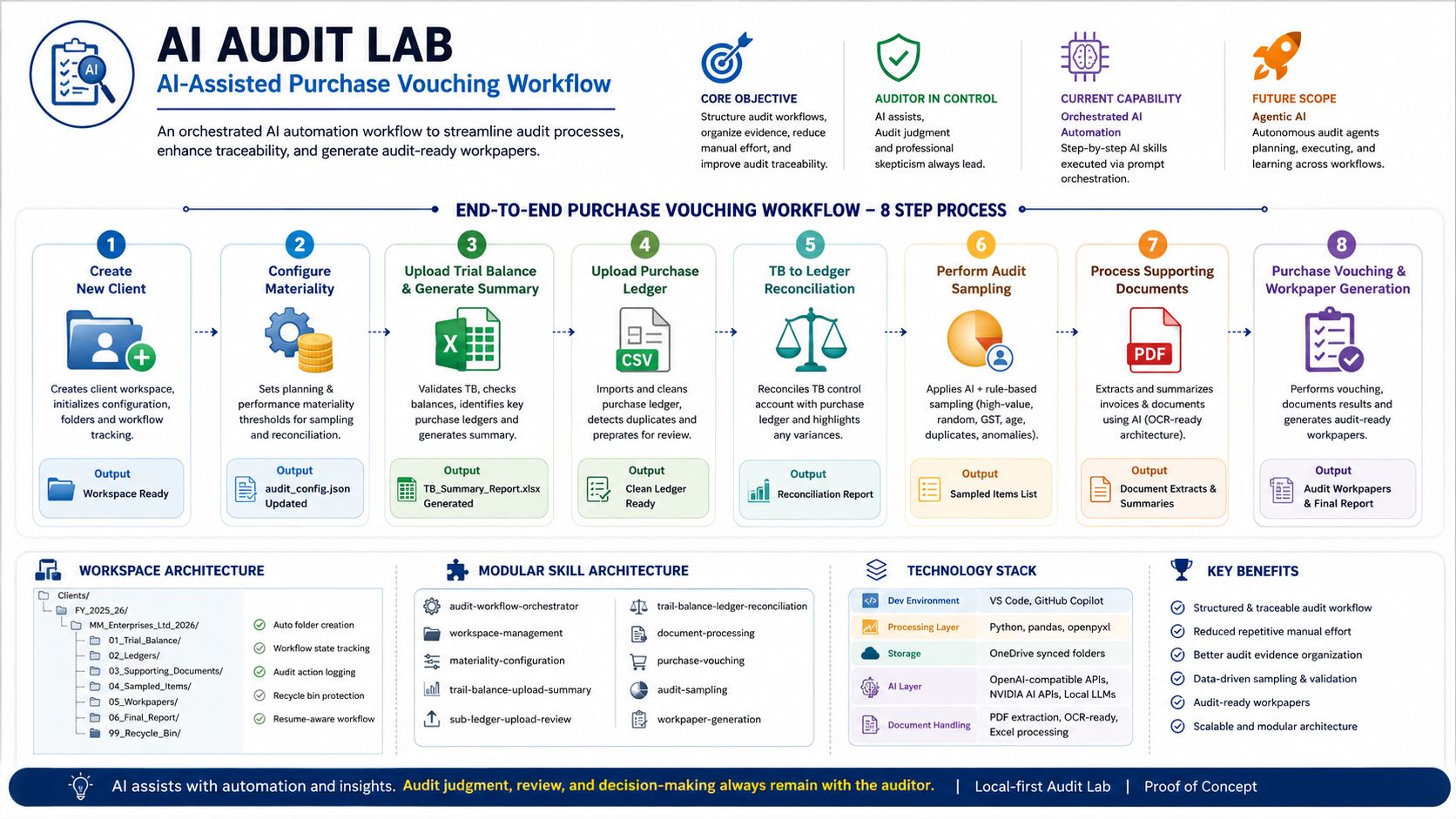
Here is how we designed and demonstrated the AI Audit Lab, an experimental local-first framework for autonomous purchase vouching.
The Hybrid Architecture: Math vs. Reasoning
In professional statutory audit, tasks divide cleanly into two operational domains:
- Zero-Tolerance Computations (Deterministic Python): Verifying that debits equal credits, calculating performance materiality thresholds, applying statistical sampling formulas, and checking GST rate math. These tasks require programmatic certainty.
- Contextual Document Interpretation (Agentic AI): Reading unstructured supplier invoices, handling handwritten receipts, classifying document types, evaluating discrepancies between PO item names and invoice line items, and drafting audit issue memos.
Trial balance balancing checks, materiality calculations, monetary unit sampling, and tax tolerance arithmetic.
Multi-format OCR invoice parsing, PO vs. invoice 3-way matching, discrepancy narrative drafting, and fraud flag evaluation.
Production-ready, formula-driven audit files with full cryptographic citation links back to immutable client evidence.
By decoupling computation from document extraction, the audit workflow guarantees mathematical integrity while freeing auditors from manual data entry.
The 5-Point Vouching Verification Matrix
When the autonomous agent evaluates a sampled purchase transaction, it subjects the transaction to five distinct audit assertions before clearing it:
| Audit Assertion | Testing Procedure | Audit Risk Mitigated |
|---|---|---|
| Invoice Match | Cross-references ledger date, amount, and invoice number against the physical invoice via OCR | Occurrence & Accuracy |
| PO Authorization | Confirms line-item unit rates and quantities match the authorized Purchase Order | Measurement & Approval |
| GRN Verification | Confirms physical delivery of goods prior to invoice certification via Goods Receipt Notes | Existence & Cut-off |
| GST Validation | Recomputes CGST, SGST, and IGST against the taxable base using current statutory tax schedules | Accuracy & Compliance |
| Vendor Integrity | Matches supplier GSTIN, bank details, and PAN against the approved vendor master | Ghost Vendor Fraud |
If an item fails any of these five verification checks, the system flags the transaction as an Audit Exception and automatically compiles it into an exception schedule for partner review.
The 8-Prompt Demonstration Workflow
The AI Audit Lab operates via eight sequential prompt gates, guided by the open SKILL.md architecture. Each step completes an isolated audit phase and records its status in a local, resume-aware execution tracker.
1. Client Workspace Initialization
Creates an isolated directory structure for the audit engagement with dedicated evidence folders and safety barriers.
Prompt: create a new client "MM Enterprises Ltd 2026"
2. Materiality Configuration
Establishes Overall Materiality (OM), Performance Materiality (PM), and Clearly Trivial Thresholds (CTT) based on benchmark metrics (e.g., 0.5% of Revenue or 5% of Profit Before Tax).
3. Trial Balance Ingestion & Mathematical Check
Loads TB.xlsx, programmatically verifies that Total Debits equal Total Credits (Debits = Credits), and flags rounding differences or ledger imbalances.
4. Purchase Ledger Ingestion
Imports sub-ledgers and converts inconsistent date formats, currency notations, and vendor descriptions into a normalized schema.
5. TB-to-Ledger Reconciliation
Executes programmatic tie-outs ensuring the detailed purchase sub-ledger reconciles perfectly with the general ledger balance reported in the Trial Balance.
6. Statistical Sampling Execution
Filters high-value items above performance materiality for 100% testing, then applies monetary unit sampling (MUS) or stratified random sampling to the remaining population.
7. Multi-Source Document OCR Ingestion
Scans supporting PDFs (invoices, POs, delivery notes) in the 03_Supporting_Documents directory and extracts key structured fields into JSON cache.
8. Autonomous Vouching & Workpaper Compilation
Executes the 5-point verification matrix for every sampled voucher and generates formatted, review-ready Excel workpapers (Purchase_Reconciliation.xlsx).
Download Live Sample Workpapers & Audit Datasets
You can download and inspect the complete, live Excel datasets and audit reconciliation workpapers generated by this pipeline:
Workspace Directory Architecture
To guarantee client data privacy and prevent cross-engagement data leaks, every audit operates within a self-contained local workspace:
Clients/
└── FY_2025_26/
    └── MM_Enterprises_Ltd_2026/
        ├── 01_Trial_Balance/           # Raw Trial Balance uploads
        ├── 02_Ledgers/                 # Standardized sub-ledgers
        ├── 03_Supporting_Documents/    # Invoices, POs, GRNs, E-Way bills
        ├── 04_Sampled_Items/           # Generated statistical samples
        ├── 05_Workpapers/              # Completed vouching spreadsheets
        ├── 06_Final_Report/            # Drafted audit summaries
        ├── 99_Recycle_Bin/             # Safe delete preservation layer
        ├── workflow_state.json         # State preservation for resume
        ├── audit_config.json           # Materiality limits & parameters
        └── audit_log.json              # Activity audit trail
Visual Demonstration & System Walkthrough
Watch the complete end-to-end vouching sequence executing inside a local-first development workspace:
Video Demonstration: Autonomous purchase vouching sequence executing inside a local-first workspace.
Architectural Blueprint
Looking Forward: From Prompt Chains to Autonomous Swarms
The current implementation utilizes structured prompt gates to ensure maximum auditor oversight. As agentic reasoning primitives evolve, the next generation of audit tools will transition toward autonomous audit swarms:
- Self-Healing Reconciliation: When an invoice number does not match due to a vendor typo, the agent autonomously queries the vendor master and suggests reconciliation without pausing.
- Dynamic Risk Adjustment: If an initial sample detects an unusually high error rate in freight invoices, the agent dynamically increases sample depth in that specific risk pocket.
- Automated Inquiry Generation: The system drafts professional, context-rich inquiry emails to client accounting personnel, complete with attached evidence clips, pending partner sign-off.
By combining the precision of deterministic algorithms with the cognitive flexibility of modern LLMs, we can transform auditing from a grueling manual chore into a high-leverage analytical discipline.


